The Big DDDay Out
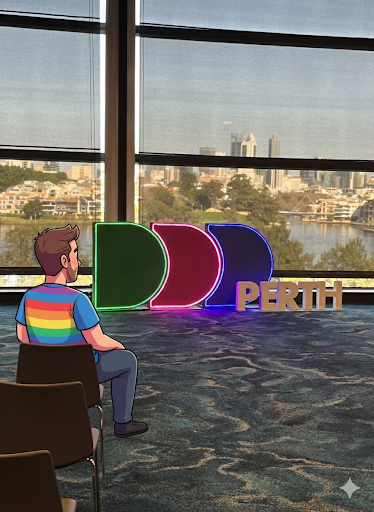
No I don’t have a stutter, yesterday I went to DDD Perth 2025 as promised. It was bigger and grander than I’d anticipated taking over a third of the stadium (up to 1300 attendees) making me want to evoke memories of Australian music festivals like The Big Day Out (to be clear I never attended those), but just for tech and also… perfect weather.
What follows below is a trip report of my recollection of the day. Use the table of contents (at right on the full width layout) if you want to jump around (I’m verbose!).
Tourism and Entry
I got free parking in the city. Hot tip: Google Street View (or Apple Look Around) can show you parking signs, just take note of the age of the image. Thanks to DDD being on a weekend with no (other) special event, I could park directly at Matagarup Bridge, which I’d never been over before to walk into the Perth (Optus) Stadium (and back at the end of the day). So I arrived early and played a bit of the tourist role first. In spite of that I never took a selfie!
Then I checked into DDD. Bit of a tech glitch - if you register late (which I did not being convinced spending my own money that I would actually go) they don’t have your ticket or food preference on the gate.
Networking
Then commenced my attempt at networking, clumsily and boy some of the things I used as opening lines were a doozy, like (upon brand recognition) “do you work for the company on your backpack, then I feel I have to apologise”. And apologise again to you know who you are, because that was clumsy opener of the day. I did better with networking in the smaller sessions including one kind person who offered to visit this very blog (thank you). But it got harder throughout the day as the schedules and sessions got compressed together and the etiquette of bothering people on their phones or the sheer crowding of the food zones came to pass. It was somewhat odd that I kept rolling the dice on who to speak to and most were only one degree removed from my industry.
I gave up on the Treasure Map competition that incentivised visiting all of the sponsor stands. There were a few reasons:
- I wanted to talk to people not brands
- I knew I didn’t intend to stay to the end, owing to the PLUG meetup immediately after and cross town and things were running late
- And because on the day they announced Ask the Experts sessions in the Chill Zone which was far more my pace at the lunch break and frankly I got great value from that
However a disclosure that “this post is sponsored” by the free socks and pen I shamelessly asked for at the end of the day from the MakerX stand.
Talks
Hopefully in short order I’ll be able to link to these talks as they should have been recorded. I certainly will be looking out for some of the talks I missed because you naturally have to prioritise
Keynote
Kate Ellis, WA’s Young Australian of the Year, founder of SheCodes, sponsor of DDD Perth 2025 opened proceedings with a talk encouraging everyone to bring out their sparkle.
She lifted everyone up with positivity about encouraging and rewarding contributions and collaboration, motivation and growth and pursuing your goals.
She associated literal Git commits to the commitment of being in a community. And I noted that I don’t put enough emoji in my code!
Session 1: AI in the Developer Hiring Process
Let me first admit that throughout a lot of these talks, they weren’t about what I thought from a quick reading of the agenda.
Here I was thinking this would be about the AI pre-filtering known to be applied to resumes prior to any shortlisting but it was actually (for me) more chilling than that, revealing that the interview process now expects you to pair program live with an AI to answer challenges. I have never done a challenge-based interview let alone seriously used an AI as a pair-programmer yet, so there’s a bit of catching up to be done!
A list of actionable strategies was given for both managers and developers advocating for accepting the reality that the use of AI coding assistants is just as normal as the expectation of an employer to provide you with a laptop. Hmm…
This is the one talk that I wanted to follow up with in Ask the Experts but I wasn’t quick enough.
Session 2: What’s the career path beyond Senior?
This entertaining talk was from a HR and development enterprise that was explaining the usual hierarchies that businesses form in order to structure their teams as they scale up.
The talk gave acknowledgement to the issue in many organisations of people only having a management pathway rather than an oft-desired Individual Contributor role.
I wrote in my notes “I feel seen” during this talk. Others that I spoke to related to the Engineer-Manager Pendulum posited by Charity Majors. I also relate to the Pragmatic Engineer of Gergly Orosz, where you lead by showing the way rather than being a manager.
The talk was packed with advice about collaboratively developing your career path considering business needs plus your skills and aspirations and that in fact it’s okay to be content and not climb the ladder. There are often family reasons behind someone not progressing into management.
Session 3: Realities of High School Teaching Digital Technologies
This talk by Courtney Weaver a software developer of 15 years turned high school teacher was very enlightening for someone who has no children and thus had no exposure to high school in decades but who still has a desire to give back through sharing knowledge.
The harsh realities of an aspirational curriculum fighting against distractions and incorrectly assumed the “intrinsic knowledge” that “digital natives” should have was explored.
Especially the user friendly and frictionless experience of iPads and iPhones have messed with childrens’ desire to explore or to know what to do on a “real” computer.
Another plea was to look to multiplier effects. Often companies and people are generous in doing things for students but doing them for teachers too, who themselves need to learn more about digital technologies, affects more students in the medium term.
I did follow up with Courtney first by being so bold as to ask a question from the floor - I identified with her parallel pathway - whether I should become a teacher - her reply was essentially you are needed but go in with your eyes wide open, and that she works much harder as a teacher than she ever did as a developer, before pointing out that there absolutely is a fast track if I was still interested; and then by meeting up again on what became an education roundtable at Ask the Experts. I certainly learned a lot about the reality of the WA education system there.
Session 4: Working with Remote Teams
Unfortunately the schedule compression meant I missed the start of this one. (In fact I had too good a time in the Chill Zone being treated like an Expert. We had a group of us here from IT support in the Department of Education, Microsoft Azure and the most passionately a computing manager from the Square Kilometre Array Organisation (SKAO).)
I had a strong interest in this one because we currently consider our work either hybrid or remote.
I have to say this talk, from Callum Whyte did feel a bit like “aren’t you jealous, don’t you want to work for us” with the company ethos around personal empowerment for leave and business expenses and the light touch for meetings - all that friction that often befalls traditional flexible working.
However ironically his company (and this is not unique in my limited experience) which splits between Australia and UK. Your commute simply switches from daily to a longer one monthly.
He gets the award for shocking statistic of the day. According to Callum most developers stay with one company for 18 months (not years) on average.
Session 5: Choose your own adventure
No seriously, you have to. This is when I went back Ask the Experts again.
Nothing from the main agenda really grabbed me here.
Session 6: Catchy title but slide overload
Despite his generic name introduction I have remembered David Smith’s name, an originally trained architect who can’t sit still through startups and so forth and finds himself on a leading edge of AI experimentation.
He’s advocating for the human-AI balance but noticing and experimenting with a lot of agentic style AI automation.
I didn’t take away as much from this speech as the others because it was quite the journey. And his slide pack was insane (the room was stacked with people who knew him it seems, and he revels in questions).
Locknote: AI is everywhere and that’s OK
I’ve never heard of a locknote, but I’ve not been at many conferences. If we weren’t running so far behind I do like lightning talks but it’s hard to coordinate them.
Before this final talk I chatted with someone who will be involved with DDD Adelaide. For once we are (not my words) unquestionably one of the best at something. Throughout the day I spoke to people from as far away as California, and…
This final speaker was again from the UK. Once we got past the obligatory Quokka selfie, we wandered around the universe of AI influences to make us feel good about everything… except for the obligatory groan about “vibe coding”. However it is absolutely clear that the developer community are using tools appropriately and that is not “vibe” coding, it’s the proper usage of just another tool.
We were left with a warm and fuzzy feeling. Some others would have been even more excited to win prizes but as I wasn’t in it to win it - I felt like I’d won just by attending - and we were sooo late, I left at this point.
I would attend DDD Perth again.